Wednesday, June 27, 2012

pnwqwtc: contemplating grace, part 1

I shared about my experience at the Pacific Northwest Quaker Women's Theology Conference in a post last week. I got to be one of the plenary speakers, so I'm going to post in three parts what I said, and a somewhat expanded version of what I wanted to say but for which I didn't have time. The topic I was given was "Contemplating Grace," as a section of the overall conference theme "Living in the Life & Power: Inviting, Contemplating & Enacting Grace." My overall desire was to help us think about the concept of grace a little bit--what does it mean to us intuitively? What baggage do we carry around this word? What did the biblical authors mean by it? Why and how would we go about "contemplating" grace, and what would this do in the world? I started off with some background information about myself and my intuitive understanding of what grace is--and is NOT. Then I went into a word study of the Hebrew and Greek terms for grace, and I finished off with some scientific (and some quasi-scientific) research on mindfulness meditation and similar topics as a little window into what it might do in the world when we "hold someone in the Light" or spend time contemplating grace in various ways.


Today I'll post the first section on my experiential understanding of grace.

Our topic for this morning is “Contemplating Grace,” and as you might imagine, I’ve been “contemplating grace” for several months leading up to this conference, mulling over what the Spirit is forming in my heart and mind to bring to you this morning. Now for me, “contemplating” pretty much necessarily includes a good deal of study—asking questions, researching, reading, discussing—and then chewing on all those things, looking for the nuggets of truth that rise to the surface (to mix a few metaphors there). So one of my first thoughts was, “What exactly do we mean by ‘grace’?” We kind of throw this word around, and it has several meanings in English, if you think about it—it’s a verb, it’s a noun, it can mean saying “grace” before a meal or a dancer who moves with grace or, more to the point here, a specific saving act of the Christian God or something to do with the notions of leniency and forgiveness. Another question came to me: “How and why would we contemplate grace?” A flood of further questions flowed from there. Do we just sit around thinking about nice things? How is the phase of “contemplating grace” different from inviting it or enacting it? As Friends, what is our understanding of grace, and how does our form of contemplation help or hinder us in the process of contemplating grace?

So this morning I’m going to start by tackling what we mean by “grace,” then add in the contemplative part. We’re going to look at everyday grace as I’ve noticed it in my life, then some word studies from the Hebrew and Christian Scriptures, and then we’ll look at some recent research on contemplative topics. Finally, we’ll finish with some thoughts about what all this means for me personally and for us as a community of Friends.
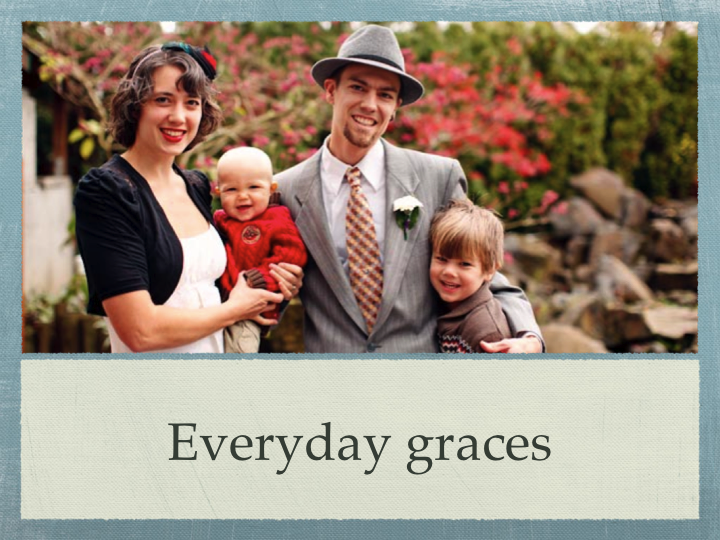
I want to start by sharing a little bit about myself and the forms of grace I encounter each day. I grew up a Quaker in Northwest Yearly Meeting and have found the grace of a family and home here. That doesn’t mean that everything is easy or pleasant here, but that I have a sense of connection and love, of rootedness and joy in the best of times, and at times a painful sense of disagreement with those I love and a difficult pull between wanting to please and wanting to have integrity about the truth I sense. In addition to this spiritual family, I’ve also built a literal family here in the Northwest. Here’s a picture of my family—Joel and I have been married almost 11 years, and that’s a grace in itself, since I come from a family of divorced parents and since relationships are never easy. I am so grateful for the grace of a life partner who’s just as stubborn as I, who will never give up on me, and who will wrestle through the hard times right alongside me. We have two boys—E is 5 and K is 18 months. I experience grace through each of them so often. K is a little love. He gives excellent hugs, throwing his little arms around virtually anyone’s neck and giving them a long, solid squeeze. I see people light up every day from the love he shares with abandon, and I desire to be that kind of person, too. E sees things going on around him and wants to help. We saw a homeless person last year and E wanted to know what we were going to do to help. We had a conversation about it, and eventually we decided to host a lemonade stand to raise money for a homeless shelter in town.

I see these small graces in the lives of those I’m closest to, though I often feel like it’s difficult to extend grace to myself, because I have high expectations for myself regarding living with integrity. But more on that later. So I have these glimpses of grace in my life and kind of an intuitive understanding of the concept of “grace” that incorporates beauty, extending more to others than is required and a gratefulness that I get to see these things and participate in them. But this isn’t a deep enough answer to me about what we really mean when we talk about “grace,” especially in a religious context. In one way, “grace” from God seems like a loaded concept, reminding us that we NEED grace (or reminding us that those who try to convince us of this theology SAY we need grace), that the world isn’t perfect, that I “sin” (whatever that is)—sometimes it feels like this sort of resigned God who is sitting around, sighing, saying, “OK, I’ll forgive you again. Here’s some more grace, since you obviously need it.” I guess what I’m saying is that when I look at the grace I see in the lives of those around me compared to my archetypal understanding of “grace” in a religious setting, I get two rather different pictures.


The problem with the way we often talk about grace in Christianity is that it almost feels like we first have to feel guilt and shame in order to receive grace. The problem with that is that grace is a free gift. I don't have to do ANYTHING--even feel guilty--in order to receive it. It's just offered to me. It’s just so abundantly above and beyond anything I can ever feel like I deserve that it feels like grace regardless of whether I feel guilty or ashamed.


The problem comes in because we think that in order to understand God’s grace, we have to think of ourselves as utterly depraved. I have a really hard time with the concept of complete human depravity. I don’t think it’s in the Bible. Yes, we’re all “sinners,” in that we all choose to walk away from God at various points in our lives (OK, every day, if you're anything like me), but I don’t think we’re at heart completely evil. It seems like Friends have generally had a fairly optimistic view of human nature: there is that of God in each of us—we’re created in the image of God. God speaks to and through each person. Everyone has the chance to respond to God.


When I was at a Reformed seminary I just could never get on board with this idea of complete human depravity, and I realized this optimism isn’t necessarily common to all Christians.  But I feel like we still have a tendency to get stuck there in this idea that we’re so evil that God had to come save us—or worse, that Jesus the Son had to come save us from God, the angry child-abusing capricious Father-deity who was willing to watch his own son die. We heap guilt on ourselves, but this distances us from God in an unhealthy way. Why should I be grateful for the grace of this God? This isn’t grace. It’s a fear-tactic. It’s holding something scary over our heads until we buckle under the pressure of our own depravity and plead with him to not be thrown in a lake of fire.  This is not the kind of grace we see in the Bible, if we really look.


The overarching theme of the Bible pictures a God who comes to people again and again to build relationship. People draw together as a community, struggling to figure out what it looks like to live in right relationship with God and each other. They make laws to try to codify what the perfect community would look like, but that doesn’t work so well. They notice that the really important part of faith is breaking down the systems (that always seem to crop up) that benefit the powerful by taking advantage of the poor or disadvantaged. Over and over again we see, starting with the law of Moses, that people are instructed to do what is right by the lowest in their society: the widows, the orphans, the foreigners. This is how their commitment to their faith is to be measured.


Stay tuned for parts 2 and 3: a word study on the Greek and Hebrew terms for "grace" and some of the scientific research that relates to the topic of "contemplating grace."

Friday, June 22, 2012

biking with kids: the next level

Last week we went to the next level in our biking set-up: we got a "tag-along bike" or "trailer bike." E is 5-and-a-half and he LOVES it! He was getting kind of big for our Burley double trailer, especially next to his 18-month-old brother. Plus, they're really heavy! We had an REI dividend burning a hole in our pockets so we sprung for the trailer bike you see below. E tried it out and was immediately hooked. Now he asks every day if we're going to be able to go anywhere on the bike. (The next thing we need to do is find some child-sized rain pants, I suppose. On Tuesday we got caught in the rain and he was soaked! I tried to convince him it was an adventure, but he didn't buy it.)

I'm not sure that the people who make the trailer bikes would officially suggest this, but we attached our Burley trailer to the trailer bike, so we have quite the train going down the road now! (I've seen other people do this, too.) It's actually made it a little easier to bike because E's weight isn't in the trailer. I suppose the extra wheel helps, and I'm pretty sure his pedaling actually helps a little bit. He can coast if he wants to, but when he pedals on hills I can tell he's pedaling. We don't go places as fast yet, because I'm making sure he's comfortable on the bike and isn't going to knock us over by leaning too far one way or the other. But I think soon we'll be comfortable enough to go at a normal speed. I can now cart around three kids, which I did the other day when we picked up my niece from Kindergarten. I assume I can also get more groceries now without overloading the trailer.

The hardest thing about this set-up is turning. I have to slow way down and make wide turns, and I have to make sure not to curb-check the trailer, since it's far enough back that it's a little bit hard to judge where the wheels are going to be once they get there. I assume this will get better with practice, so for now I just take it really slowly and it's been fine. Hills are also really difficult. I have to make sure to shift down with plenty of time or else all the momentum starts pulling us back too much!

My only criticism about this trailer bike is that it's kind of difficult to switch from one bike to another. It's not impossible but it takes a bit of effort to get it on properly. Once it's on it works very well, however.

If you're interested, check out this page about raising up biker-kids. You can see a trailer bike in action in a video. There's also a helpful video about teaching kids to ride a bike. (We've been using the push-bike method by just taking the pedals and training wheels off E's bike. He's getting the hang of how it feels to balance, and I'm pretty sure he'll be riding his own bike within the next month or two.)

Wednesday, June 20, 2012

pacific northwest quaker women's theology conference 2012, part 1

This last week I went to the Pacific Northwest Quaker Women's Theology Conference. It's a conference that happens every two years and brings together Quaker women from all over the Northwest (and beyond) and from the different Yearly Meetings and unaffiliated meetings in the area. In this post I'm going to tell you a few of my reflections from the conference and copy the really beautifully-written epistle that came out of our 4 days together. I had the chance to be one of the plenary speakers, so in future posts I'll write about what I shared with the group. I'll actually write an expanded version, because I had about 25 minutes to share and at least twice that much material (as usual)!

I am so grateful I had the chance to attend this conference. I've been wanting to go for the last several years but it hadn't worked out, so finally I got to go this year. The goal of the conference is to bring women together from different communities of Friends to build relationships and share about our faith journeys through narrative theology. I actually love spending time with Friends from various traditions, and as you know if you've followed my blog, I love theology. So this was right up my alley.

One thing that was fabulous for me personally was the space to sleep, pray, exercise, eat and participate in conversations without interruption by two little ones! My boys are great, but it was amazingly nice and restful to have a few days without them at a retreat center (Menucha) surrounded by women I enjoyed spending time with. My friend Darla and I went running almost every day (the last day we finally gave ourselves enough time to make our goal of finding the end of the Women's Forum Trail--kind of a good metaphorical end to our week--and we got muddy up to about mid-calf) and I practiced yoga with a few others under the direction of an experienced yoga-teacher-Friend, Ellen.

I also found it stimulating and encouraging to find Friends with whom my heart was in resonance from several other yearly meetings and unaffiliated meetings. I will treasure these friendships, and I'm excited to see where they go in terms of drawing us together as Friends. I hope we can start working together better on things we all care about, and that maybe we can start doing a bit more inter-visitation.

I went to Marge Abbott's workshop on prophetic ministry, which was excellent. I am so grateful that God is working in so many of us to bring truth to our communities through our own voices and talents. Prophetic ministry is a lonely business, and though most of us didn't have others there in that workshop from our own meetings, it's encouraging to know one another is out there, listening and attempting to follow through with action as led.

One woman I will not soon forget is Carol Urner. She came as another of the plenary speakers, and she's an octogenarian from Whittier Friends in California. She spoke about some of her experiences and ministries, and her main point was that we should "say 'yes' to God, even when we don't know where that will lead us." This, of course, is what we all strive to do, but she spoke with amazing passion that can only come from decades of putting this advice into practice. When I'm in my 80s I hope to have at least half the passion and stories of faithfulness that she has!

There were many other wonderful women and great events, but I think that's enough for now. I'll copy the epistle below so you can read of the communal experience we shared.


Epistle of the 2012
Pacific Northwest Quaker Women’s Theology Conference
June 13-17, 2012
Corbett, Oregon
Greetings to Friends everywhere. 
Grace permeated our days and wove the variegated fibers of our lives together into a tapestry of light and love much like the quilts that surrounded us in our meeting space at the 2012 Pacific Northwest Quaker Women’s Theology Conference. We gathered on June 13, 2012, at the Menucha Conference Center above the Columbia River near Corbett, Oregon, around the theme of Inviting, Contemplating, and Enacting Grace. Prior to the conference each participant wrote a short essay in response to the theme. The conversation among us began as we read each other’s papers online and throughout our time together.  We came with differing experiences among Friends and other faith traditions, some excited, others tentative about what we would hear, and feel, and do together. We came yearning for community, a place to feel at home. We came knowing we would be challenged to listen deeply, to learn to open and stretch, hoping the effort would yield deeper understanding and add new patterns and textures to our tapestry of grace as we were woven together.

Thursday morning we received a message from Ashley Wilcox on Inviting Grace.  Ashley opened with her admission of love for the Apostle Paul. Drawing from Acts 9 she showed us that sometimes we invite grace through doing the completely wrong thing.  We can also invite grace into our lives by accepting and giving loving acts and living words. Darla Samuelson taught us how to use specific disciplines to create a space for grace to touch the pain of shame that is common in human experience.

Friday morning Cherice Bock led us through a contemplation of grace through a word study.  She asked the provocative question, “Do we have to feel guilty to receive grace?” In answer to her own question, she proposed that grace is an undeserved gift with no strings attached. Cherice concluded that grace is active, social, and enduring. On Sunday morning we were gathered together for a final hour of worship in which Nancy Thomas brought us the challenge to carry gratitude with us in response to God’s grace.
As stewards of grace when we extend grace to others we receive grace into our own lives and are further called to extend grace in this world. Christine Hall continued by saying that in contemplating grace we are swept up in a love that connects us to God, one another, creation, and divine mystery.  She finished with a quote from Thomas Merton stating that through contemplation we “see through the illusion of our separateness.”    
Saturday, responding to the theme Enacting Grace, Carol Urner challenged us to say “yes” to leadings even when we do not know where our “yes” will lead us.   In that “yes” there is a river of light that will flow through us and sustain us.  Elenita Bales followed and reminded us that that the word “enact” contains “act.”  She encouraged us to develop a rhythm of faithfulness in speaking the truths that emerge from our souls, and to risk vulnerability that we may become a channel of change.  Quoting historic Quaker Ann Wilson, Elenita asked, “What wilt thou do in the end?” 
Afternoon workshops presented a variety of ways we can nourish our lives and create an opening for grace. In Writing as Spiritual Practice we explored several ways to begin and be faithful to our own spiritual writing.  A workshop on the Bible revealed that in spite of feelings about Scripture, ranging from anger through love, the group had an interesting and respectful discussion.  In a session entitled Speaking Holy Boldness participants considered viewpoints and experiences that made clear that prophetic witness is alive and well in our yearly meetings.  Another group shared the different practices, such as movement, meditation, prayer, and visualization they use to hold others in the Light.  In a session entitled The Hard Stuff women from different yearly meetings responded to questions that had been submitted in writing earlier. Participants engaged in respectful discussion that acknowledged our differences while encouraging understanding and acceptance.  One workshop focused on listening and care committees and offered guidelines and tools on how to support others through suffering. Judy Maurer shared her experiences and reflections on teaching, listening, worshipping, and working on social justice issues in Russia. Christine Hall introduced Way of the Spirit, an opportunity to engage in contemplative study through a new program in the Pacific Northwest. 

Evening activities provided opportunities to further be woven together in our tapestry of community. Thursday evening Roena Oesting, dressed and speaking as Elizabeth Fry, recounted major events from “Betsy’s” life as written in her journals.  We expressed gratitude for the way Elizabeth Fry’s work in prisons started a pattern of prison reform work among Friends that continues today. On Early Friday evening we listened to the experiences of those who attended the FWCC Sixth World Conference of Friends in Kenya. Their exchanges were fruitful, rich and full, though sometimes difficult. As we heard their stories we could sense that there, too, they were held by grace. Later, we danced, sang, played Hearts fiercely, worked on a HUGE puzzle, and created art.  All these allowed for new openings into one another’s hearts and connections through joyful exchanges. 

Throughout the conference threads of conversations at meals, home groups, over the puzzle, or on hikes further wove us together in beauty and grace. It was an amazing gift to sit at a meal and turn to a stranger and feel no awkwardness. On Sunday morning we were gathered together for a final hour of worship in which Nancy Thomas brought us the challenge to carry gratitude with us in response to God’s grace.  We came here to be ourselves and left affirmed in our appreciation for and joy in the deepening cross-yearly meeting friendship; that is grace.  Borrowing a sentiment from Carol Urner, we have to finish, but we have not yet begun. 

Thursday, May 17, 2012

moms & gardening

Since we just passed Mothers Day, I've been reflecting on the moms in my life, and on my own status as a  mom. (Here's me with my mom and sis last weekend!)

For the record, I wish that Mothers Day was Women's Day or something (and Fathers Day changed likewise), because I feel like it means we only celebrate those who have kids, as if only parents are valuable members of adult society. Having kids doesn't make us somehow whole or better, and it is not only our parents/grandparents who've shaped us. Why not celebrate all the women and men in our lives who have influenced us into being who we are today?

Anyway...growing up, I lived on 5 acres a few miles outside of a small town. (That is NOT me in the photo at left--this is my eldest last weekend when we went to the Bloom Festival at Tryon Life Community Farm.) Our 5 acres had a forested canyon, wide open fields and a huge garden. It was mostly my mom who grew vegetables, raspberries, kiwi, blueberries, rhubarb and strawberries. I remember my own little section of a bed one year in which I grew nasturtiums and cucumbers, but I wasn't really much of a gardener. My parents paid me 5¢ a hallek to pick berries, but other than that I was mainly tromping around in the canyon or inside reading books. My mom spent hours out in the garden and she enjoyed growing things, for reasons I couldn't really fathom as a kid.

My mother-in-law is a very talented landscape designer and she is also an excellent gardener. She and my father-in-law have transformed their .91 acres in town into a beautiful space that also produces a lot of food for them. They work together: my mother-in-law creating the plans and using her wealth of plant-knowledge to grow things, my father-in-law doing a lot of the weeding and harvesting, as well as picking fruit from the trees and drying it. We all worked together in the last 10+ years to create a trail that winds through the yard and a brick patio just outside the back door, but it's my mother-in-law who had the vision and could make the plan. Through her vision they've created a sanctuary back there that is beautiful, kid-friendly and lush, meditative and fun, practical and exotic.

(My step-mom has taught me a lot, too, but I've talked about her influence before, and though what I've learned from her has been similar in terms of creativity and the importance of doing things that are literally life-giving, her influence has been on slightly different topics. Many, many of the novels I've reviewed on this blog have been ones I've received from her. She's taught me a lot about what it means to live art, to cultivate and honor feminine spirituality, and to love dark chocolate and tea!)

My mom and my mother-in-law are very different people, but they both find joy in growing things. They, like the physical spaces they create, are beautiful and practical, joy-filled and in-process.

This year, we're putting a lot more time and effort into our little suburban farm. It's interesting, because I really don't like the concept of land ownership, especially since we took this land from Native Americans. It bothers me that this land is "mine" (at least it will be once we pay off the mortgage). It helps somewhat that it's not just mine, but it's my husband's and my mom's and it also belongs to my kids--we live in community, we bought this house and the lot on which it sits together. I struggle with the idea that we can "own" land.

And yet, having a sense of "ownership" for this land has been really helpful, too. We're learning to care for a physical space in a way we never have before. We're making it our own, but we're also attempting to make it beautiful and functional in order to better sustain life here and around the world. We have our own chickens, as I've discussed before, and we have a small garden this year. My mother-in-law made us an absolutely beautiful landscape plan for the back yard, which we mainly implemented last summer and are still working on this year. Incrementally, the space is coming together. And little-by-little, I'm learning to grow green things. In our garden we have raspberries, blueberries, strawberries, various lettuces, carrots, onions, potatoes, tomatoes, squash and pumpkins, peas, and we'll soon plant beans.

We also joined a community garden this year. We have a bit of space but not tons of space, so it's good to be part of a community of people who are growing some more things. Each individual or family is in charge of a bed, growing a particular thing. We meet for a few hours on Wednesday nights to weed, plant, harvest and share a meal together, and then we tend the garden when we can throughout the rest of the week. We're in charge of the peas and beans, and EP wanted to plant some flowers, so he has a little bed where he planted sunflowers. Hopefully it will turn out a little bit like the sunflower house pictured here. I'm excited to be part of this community! I want to learn what others know, experiment together and build community in the process.

I reviewed the book Dirt & the Good Life a few weeks ago and I'm excited to start putting this into practice in my own life. I'm grateful for the moms in my life who have cultivated me, even when it's messy and tedious and takes years and years and doesn't always go as planned and feels more like an experiment than something about which we have real expertise. By now they're "expert" moms, though, and I can go to them for advice not only about actual gardening but about growing up kids!

(By the way: another backyard project right now is the clubhouse that Joel's building for the boys! This blog post wouldn't be complete without some pictures of that! We also built a raised bed. By "we" I mean I cleared the space and measured things, Joel and Mom built it and I took pictures. There are also some pictures of us clipping the chickens' wings.)


Thursday, May 10, 2012

book review: the hunger games (& american politics)

I jumped on the bandwagon. I had emphatically decided I wasn't going to jump on this one, due to what I'd heard about the books' theme of children killing children in a Roman arena-like setting. I didn't want to support that. Even when I heard that the hero is actually a heroin and even when several of my friends read it and liked it. I also kept hearing stories on NPR, of all places, in the weeks leading up to the release of the first film: about the explosive popularity of the sport of archery, especially among girls; about women archers training for the summer Olympics; and of course buzz about the movie. (Warning: if you haven't read these books and plan to, go read the books first so I don't spoil anything for you!)

Then my husband threatened to go see the movie with or without me.

OK, OK, I'll go see it with you--but wait till I've had time to read the book first!

That was on a Saturday night. We watched the movie two days later on Monday night. And I'd finished the first book that afternoon, between taking care of kiddos (mine and my niece), prepping for and giving a lecture, doing my normal Sunday routine including meeting and an evening worship group which we hosted and for whom I made dinner. I got the whole trilogy on Kindle, which meant a) I didn't have to wait to buy the book at a store or have it sent to me, and b) I got the whole trilogy, which meant that immediately after I finished the first book I wanted to dive into the second book! I tried to show a little more restraint on the second one, but I started it Tuesday and finished it Thursday that same week. That's when I put my foot down and decided that I had to save the third book for the end of the semester, after I'd finished all my grading.

So as you might have guessed, I found these books extremely addicting, in a good way. I don't know that there's anything particularly amazing about the writing style in itself, but the story is compelling and the plot development is excellent. It's told in the first person from the perspective of the heroin, Katniss Everdeen. (Katniss is a cool name, by the way! If I had a daughter, and if I didn't think that name will soon become too popular, I'd totally name her that.) The world in which the Hunger Games books are set is a dystopian version of the future United States. It's no longer the United States, but it's set in the land where the USA is now. The government reminds me of the one in 1984: a centralized government  that has eyes and ears everywhere due to technology as well as human informants; theme of escape to the wilderness for respite; attempted control of the people via specific work assignments not based on aptitude but on location, etc. In The Hunger Games, the government is run from "The Capitol," and there are (or were) 13 districts, each in charge of certain things needed: agriculture, coal, weaponry, seafood and so forth. Each year they have what's called "the Hunger Games," where two contestants are chosen at random from each district to fight to the death in a human-made arena, but it's made to look natural (i.e., it's in a forest or whatever). Thinking about these Games defines the lives of most in the Districts (and in the Capitol): teenagers can get extra food for their families if they put their name in more times for the lottery. Watching the Hunger Games on TV is mandatory for all. In this way, the Capitol keeps its subjects...subjects.

Obviously, Katniss ends up in the Hunger Games. If you've read it, you know how--if not, go read it. The author, Suzanne Collins, created an interesting world where the contenders in the Games have to play to the crowd in order to have a chance at winning. As a reader you end up hating the people from the Capitol--but there's that point in the story where you have to realize, "As an American, I'm from the Capitol." We watch other people's struggles for existence on TV, and if their story captures our imagination it's possible that we'll send little gifts into the "arena" of life to give a little edge over competitors. This is "entertainment" for us and nothing more. As a middle class, educated American, I can spend my life learning about wars and conflicts, perhaps, and I may be genuinely sad when favorite "contenders" die, but I move on, happily raising my kids in this safe zone where they'll never have to fear becoming a contender in the real-life (life-or-death) Hunger Games.

And then there's the issue of politics and "spin." Katniss recognizes she's being used as a peon in a political game by everyone possible, and she (rightly) resents this. First she's used by the politicians of the Capitol to continue their game of subjugation through fear and degradation of the human spirit. When she later becomes the symbol of the rebellion of the Districts against the Capitol, she realizes she's being used again. She's willing to be used as a symbol--but only so long as this symbol is a rallying point for changing the political landscape into something that is more fair and equitable for all. When she realizes the politicians of the new order are going to reinstate the Hunger Games against the people of the Capitol (and several other inklings before this), she can't stand it anymore. She knows the political system that is going to be put in place will have exactly the same result as the former government did. The people at the top will be different, but there will be a "top" and there will be a "bottom." The system will remain the same, though the individuals will be shuffled around a bit.

This is what it feels like in our country right now. I vote, but I vote without a clear conscience. I vote for the least of two (or more) evils; I vote because I think this is the best system we human beings have thus far come up with--but I think this system is broken. Or maybe it's us who are broken--maybe it's me. We're so broken that it really doesn't matter which party is in power; we're going to bomb Iraq, Afghanistan and who-knows-how-many other countries almost daily. We're so broken that most politicians in both parties are cozy with Wall Street tycoons, special interests and lobbyists. We're so broken that if you get down beneath the rhetoric of most politicians, everything they do seems just about the same.

I believe there are good people in positions of political office, but we and the other lawmakers are making it pretty much impossible for them to get anything done that is actually good for anyone (or anything). We demand that they not change their mind, that they hold an extreme viewpoint on everything (either extreme right or left), and this makes it so no legislation can pass--and if it does, it's bogged down in loopholes or special interests. It doesn't matter who's in power--these things occur.

This brings me back to the Hunger Games. I guess I'm excited to see if this book catapults us into thinking about government differently. Can we see ourselves in the people of the Capitol? Can we see the obvious critique in the text of a simple change of hands of the same old power? Can we begin some kind of revolution to change what's going on--and do it in a way that will usher in something truly different rather than more of the same? Will Friends lead this charge, or back off until it becomes trendy?

Wednesday, May 02, 2012

bike experiment results

Last week saw the end of our self-imposed, month-long biking experiment, so I thought I'd share our results and my reflections on the experience. The experiment consisted of my husband, Joel, and me trying to bike (or walk) as much as we can and trying to drive less. We kept track of the number of miles we biked, walked, drove our car for fun or necessity, drove our car for work, carpooled in our car and carpooled in other people's cars. So first off, the numbers (based on 20 mpg and $4/gallon):

Miles biked: 189.3     (saved about $38 and 9.5 gallons of gas)
Miles walked: 10.6     (saved about $2 and 1/2 gallon of gas)
Miles carpooled: 270.9     (saved about $54 and 13.5 gallons of gas, since otherwise there'd be two cars driving that distance)
Miles driven for fun/necessity: 527.7     (spent about $106 and 26.4 gallons of gas)
Miles driven for work: 333.5     (spent about $67 and 16.68 gallons of gas)

So...we didn't do all that well, by any stretch of the imagination. I mean, we certainly biked more than usual, and saving $94/month and 23.5 gallons of gas is SOMETHING, but it's not huge. At the same time, if we did this every month, that would start to feel a bit more significant. That would be close to $1200/year and close to 300 gallons of gas. What if every family in the United States did this?

A few things that stand out to me: first, there was only one day in the entire month that I didn't ride my bike. I rode an average of 4.4 miles/day. But if you average out all our driving, we drove an average of 36.52 miles PER DAY! Ouch. Some of that was for work--Joel had a couple work trips and several photo-oriented shorter trips. Even if you take out all the work and carpooling, we still drove an average of 17 miles per day for fun or what felt like necessity at the time.

Partially, this experiment was just humbling. I don't tend to think that we drive that much, but keeping track for a month really made me aware of how much we just randomly decide, "Hey, let's go do such-and-such," of an evening or weekend, and we just go do it. This month we even kept ourselves from acting on some of those impulses because we were trying to be more intentional about not driving as much. Sometimes we tried to combine trips so we only had to go once instead of a number of times, so that was good. Imagine what a normal month looks like where we AREN'T being that intentional!

This month was also strengthening. It was physically strengthening, in that my muscles are much stronger. I noticed a huge difference from the beginning of the month where I could hardly drag my two boys up the last hill to our house, to the end of the month where I could do it without being too out of breath in a higher gear. It also reminded me of how much I enjoy biking and being outside. I really enjoyed the fact that I got to be outside a ton more this month than usual. It's spring so I noticed things budding and leafing out. My resolve for biking in the rain was also strengthened. I had my rain gear all organized and ready to go at all times, so it wasn't hard to just pull on the rain gear and be on my way just as if it were sunny. My resolve for biking in general was also strengthened. I plan to keep working at this and try to increase the number of miles I ride each month, at least for the summer (or maybe do better on the ratio of walking and biking to driving.)

Biking every day became a habit. At the beginning of the month my then-16-month-old would often ask me, "Go? Go? Go? Car? Car?" By the end of the month he'd changed it to, "Go? Go? Go? Bike? Bike?" He hated wearing his helmet at the beginning, but now it's just normal. The boys do get a little frustrated if I forget to bring snacks for them to have in the bike trailer, though! (Fruit leather, string cheese, cheddar bunnies...)

This experiment brought me face to face with my own sense of entitlement. I had a hard time knowing when I should sacrifice what I or my family wanted to do and when it was OK to drive somewhere, just this once. I felt entitled to go hang out in a coffee shop in the next town with some friends on a Saturday afternoon. I felt like it was necessary to meet a couple for whom we're doing premarital counseling in locations 40+ miles away more than once this month. Sometimes we "had" to drive to meeting because we had to get our two kids plus a guitar there. Sometimes I drove because I was late. I felt entitled to drive to another city for date night. It was really interesting hearing my internal justifications, and noticing how I set up my schedule and my expectations around assuming I'll be able to drive. One thing I didn't even TRY was public transportation. We have a new system of public transit in town and I have yet to set foot on it, though I think it's great. But if I'm honest I must admit that in some ways I think I must feel entitled to not have to take a bus.

Overall, this experiment was a good experience. I probably showed up places a few minutes late and overly-bedraggled and sweaty, but hey--my conscience was relatively clear!

So I'm going to keep working on this. It's kind of exciting because I recently heard about something they're doing in our little town called the May Walk & Bike Challenge. They've been recently promoting biking a lot more: there's a new bike map and some new bike symbols on the side roads. There's going to be a summer bike festival! So it's cool that our little town is really trying to do something to promote this healthier way of living--healthier for each of us and for our world. I'm going to participate in this Walk & Bike Challenge, and I hope many others will, too!

Saturday, April 21, 2012

pedagogy

I've been adjunct teaching at the undergraduate and masters level for about a year now, so I thought I'd reflect a little on what I've learned and my own personal pedagogy (teaching style) at this point.

First, in this day and age, one has to be fairly careful about what one puts out there online when one is a teacher! It's a little weird to write publicly about teaching, because who knows which of my students will find my blog at some point--or if they're my "friends" on Facebook, then they will see that I post. (If I taught underage kids I probably wouldn't accept them as Facebook "friends," but since I'm teaching adults, some of whom are my friends in "real" life and not just online, it ends up that some of my students are also my Facebook "friends.") I sometimes post things about sitting around on Friday nights grading papers, or I post my lecture topics, but I'm definitely careful to make sure what I say online is responsible and respectful.

I feel like at this point I need to go read everything Parker Palmer has ever written! (He's a Quaker who writes about teaching.) I've read a couple of his books, but I need to re-read them, and read everything else. I really appreciate what he has to say about creating classroom space that is egalitarian rather than too teacher-focused. This is something I want to do better. I find it difficult to make sure this happens, but at the same time to make sure students feel they are getting their money's worth, or that they are learning the information they want/need to know. Part of this is the academic system we currently use. It is information-focused and teacher-centered, so that is basically what students expect. They expect that if they are taking a class, the teacher will be the "expert" (at least compared to them) and will impart knowledge, which they will soak up. Parker Palmer talks about a pedagogical setting where all participants are both students AND teachers.

I try to do this in that I have students give a presentation at some point during the class. Therefore, they are the expert-for-the-day at least once during the semester, and they get used to listening to one another and valuing one another's input. This doesn't go as far as what Palmer suggests, however, because the model is still the same: someone is standing at the front and imparts information that they learned from books and experts. But at the same time, it helps students to feel confident in something so that everyone has a chance to contribute something important to the discussion at some point. There are many students, it seems, who don't feel comfortable speaking up in class, but if given the microphone (so to speak) they will talk for a long time!

I also try to incorporate quite a bit of discussion and to make sure that people feel comfortable asking questions. My best-laid plans don't always work out, however, and often the class time is all used up by lecture and other details and there isn't enough time for discussion. I try to set aside specific days for discussion only.

Grading is one thing that I've found is not my favorite thing. I know this goes for most teachers! I am learning to assign things that I enjoy grading, but with undergrad general ed classes, it seems like it's necessary to assign things that will encourage students to process the information and to learn it in-depth, and that this learning doesn't really happen unless you force them to do it. Students complain about how much work they have to do, but the prof has to do the same work x40! It's definitely a challenge to keep up with all the grading and to give them helpful, constructive feedback.

One thing I really try to do is to require an active element outside of class. I taught a class on spirituality and social justice, and required that each student do some sort of social justice volunteer work or action of some kind. For Bible survey for undergrads, I asked them to do a research project that incorporated a paper, a presentation and a creative or active element. It was amazing to see the creativity so many of the students used! Some wrote poetry or music, some made movies, some served in their church, one person memorized a passage of scripture in sign language, some students incorporated what they learned into their sport, some made art projects, some had conversations, one created a dream journal and another started a spiritual journal, and many other things. It was wonderful to hear how they connected with God and connected with their biblical topic in new ways through their creative or active portion.

Overall, I've learned that I really enjoy teaching! I actually love it. I really do like the grading, too, except for that since I'm kind of just teaching on the side at the moment, I don't have time to do it. But I like to read what they have to say and to find out whether or not they're learning the things I'm intending them to learn. I assign journals for the general ed classes, and although they take quite a bit of time on my part, they're some of my favorite things to grade because I can see their worldview growing right before my eyes. They open up to new concepts and new ideas, and so many of them are incredibly receptive to this new information and to the spiritual growth that the new information encourages. I love to see how God is working in their lives through their interaction with the texts and other materials we're learning about as a class.

My only hesitation with teaching is that I feel like I can so easily get sucked in to the academic world being my whole world. I talk about social justice and the equality of all people, but I just sit around in my suburban ivory tower. I don't really have time to do anything else! I think pretty much one could spend all of one's free time on one class and still not do it perfectly, because there's always more preparation or a more creative way or a little bit more attention to grading or any number of other things to be done--not to mention one's own research and writing for publication. So I'm not convinced that this career path is entirely healthy for me. By no means is it easy, but it's safe (in some ways)--I'm comfortable with academia and with the kinds of questions it raises. There are areas where it is not exactly safe--what happens when I disagree theologically with the institution I'm representing? Is it possible for me as a woman in academia to be myself and to still have a viable career? I'm not a big fan of dealing with politics in terms of "playing a game" to get ahead in a career, so I'm not altogether certain that I'll be able to get very far beyond adjuncting. But these are not the kinds of "safety" questions I would have to deal with if I chose a career path that was more social justice-oriented.

For now, though, I'm definitely enjoying teaching and I'm hopeful that it will lead toward a career that challenges me in all the right ways, and in which I can be my best self and encourage students to be their best selves, too.