Wednesday, August 29, 2012

friendly water for the world training

Lately, Joel and I have been feeling led to live out our belief in creation care, eco-justice and sustainability in more practical and active ways. We've been hearing for a couple years about the work of some Friends in our Yearly Meeting who are training people the world over to make biosand water filters, which are relatively cheap and simple-to-make water filters that can help families and communities have easy access to clean water. Their organization is called Friendly Water for the World. They're doing a training in the Northwest in about a week and a half, and we're going to go to it! We don't know exactly how we'll end up using the training, but we have several ideas, so we'll see how the training goes and what comes of it.

If you're interested in helping us get to the training, it costs $329/person to cover the space, food, supplies, etc., so we'd love to have you partner with us in this endeavor. If you could even contribute $5-$10 we'd be eternally grateful!

Monday, July 09, 2012

pnwqwtc: contemplating grace, part 2

Here is part 2 of the talk I gave at the Pacific Northwest Quaker Women's Theology Conference last month. If you missed them, check out my posts on my experience at the conference and part 1 of my talk (which covers my kind of intuitive understanding of grace and some of the negative ways we interpret grace in traditional Christian theology). Below I discuss the terms used for "grace" in the Hebrew and Christian Scriptures, and also a bit of an explanation as to why I find the Bible helpful in thinking about Quaker theology and matters of faith, since Quakers at the conference hold differing views on the Bible and its worth. Soon I will post part 3 of my talk, which focuses on the idea of contemplating grace. Why would we contemplate it? What might that look like? What might happen if we contemplate grace? You can look forward to some scientific studies in that one, but for now, here is part 2, which discusses the more complete meanings of the words for "grace" and my view on why the Bible is important and useful in such discussions.

I decided to do word studies on the words we translate as “grace” in the Hebrew and Christian Scriptures, because I had the inkling that the more stereotypical understanding of “grace” that sometimes comes across when we talk about God’s grace isn’t as full as it was meant to be. Now, I’m pretty sure that there are as many understandings of and feelings about the Bible in this room as there are people, so I wanted to explain a bit about why this is important to me. For me, the Bible is a record of how God has worked in and through people across time—it shows people’s struggles and successes as they work to hear and follow God. It’s a community of which I am still a part, a community of some like-minded people across time, though I wouldn’t say I resonate with all of them. But, at least for me, it’s a starting place. It’s a place where I can meet God by seeing this struggle for people to put their experiences and desires and spiritual connectedness into words. I personally struggle with the balance between laws and freedom, and I see that struggle all through the Bible. How can we be a safe, connected community attending to the present, living God? Where is the center? How do we make sure we’re all going in the same direction? What do we need to prescribe, and what limits our ability to respond to the spontaneity of the Spirit? I think these are probably questions that affect our meetings, and definitely have affected our divisions as Friends. I think they also have to do with grace: in what ways is God gracious, and in what ways is God judging, merciful, righteous, holy, and all those things we attribute to God? In what ways are we to be gracious to each other, and to ourselves? What's the difference between being gracious and being taken advantage of? At what point do we take a stand against something that seems to go against our understanding of the Inner Light, and at what point do we trust that God is speaking through someone else inwardly on a matter we thought we heard God speak differently?

So the Bible is important to me as I see people struggling to answer these questions with God and as communities across time. This is why I wanted to do a word study on the words we translate as “grace” in Greek and Hebrew. Like I said before, part of “contemplating” for me is studying. I find God a lot through research and really digging into questions I have, seeking and processing. I wanted to understand what people meant in the Hebrew and Christian Scriptures when they talked about grace, perhaps before we loaded a whole bunch of theological baggage on the term.

Without further ado, the word studies! The Hebrew words we sometimes translate “grace” are hanan and hesed. Hanan most often means “to show favor,” and people in the Bible often ask God to show them favor, as in, “Be gracious with me, O God!” It’s usually coupled with mercy, and often has a sense of motherly compassion. We can’t merit this grace, but we can expect that God will show it to the poor and oppressed—and won’t grant favor on us if we’re not a friend to the poor and oppressed.

Hesed is a really interesting term. Its basic meaning is “to do good.” It’s the grace of enacting goodness toward another. It’s reciprocal, but not in an obligatory way. It’s a good action that draws out goodness in the other. God shows us this kind of grace and we can’t help but respond with enacting grace toward others—not because we have to but because it just flows out of us. It’s not a legal word. We’re not REQUIRED to reciprocate it, and we can’t do anything to merit it. It’s a word that requires relationship. When we’re in a true relationship, hesed happens. Hesed is active, social and enduring. It’s not something that we get and we’re done with it, but it’s an action that happens between people, or between people and God (or I suppose between people and other created things), and it flows on and on because of the reciprocal nature of it. Hesed seems to encompass what this conference is talking about when we imagine “inviting, contemplating and enacting” grace. It includes each of those steps.

So that's the understanding of grace that was going on as the Jewish Scriptures were written, though they (as we) always had a difficult time actually living it out. Then Jesus comes along and actually enacts this idea of hesed. He invites his followers into relationship with a God who is so close, God is their parent—they’re (we’re) adopted into God’s family. This relationship is so good, so unmerited, so joy-filled that we can’t help but reciprocate and pass this grace along into the world, enacting hesed especially toward the poor, the outcasts, those who feel lost or unlovable.

The Greek word that early Christ-followers used to describe this kind of grace is charis, and it is integrally connected to the words chara: joy, charismata: gifts of the Spirit, and eucharisteo: giving thanks (later formalized into the Eucharist, the sharing of the body and blood of Jesus in the act of communion). Early Christ-followers saw God’s grace in the life (and especially the death) of Jesus: God dwelling with us, suffering with us, dying because of our inability to let go of our desire for power, wealth, glory, etc., and showing us that God’s grace—God’s goodwill toward us and God’s stubborn desire to give us good gifts—cannot even be stopped by death. God isn't a blood-thirsty God of capricious anger, holding us accountable for sins we are born into and can't avoid. Instead, God is a Being who knows us completely--knows that our curiosity and stupidity, selfishness and fear often get the better of us--and yet, God still loves us and extends every grace to us. We can accept this grace and live into it and in so doing, be drawn into this reciprocal cycle of love, grace and release from fear of death, or we can continue in our stubborn way of wanting to do everything on our own, getting stuck in the well-documented cycle of violence against ourselves and others. Jesus' death shows us those two choices. Those who killed Jesus (and they could have been any of us, had we lived there and then!) show the fear of losing power and control, the fear of a truly equal society, the fear of there being not enough so I have to hold onto what I can for me and mine. Jesus shows us the grace of God: in Jesus' incarnation as God's self in the flesh, we see a God who understands the human propensity to turn away from God and grasp at power, and we see God's love in the face of that. We see a God who accepts that about us, but doesn't allow it to be the last word. God extends us the offer of freedom from fear, even beyond death.

The Greek concept of grace is all bound up with joy, gratefulness and the receiving of good gifts, even though we don’t deserve them in the slightest. This connects with the concept of hesed, because it’s out of this space of joy, out of our gratitude for this unmerited love and abundance being poured out on us, that we can live graciously in the world. Hesed includes justice and mercy and righteousness. It isn’t an empty or paternalistic gift, but a joy-filled freedom to love with abandon, without fear of there not being enough, because we’ve experienced that there’s always more. There’s always more grace on its way, and we can rest in that.

For today, I'll leave you with a few thoughts on our understanding of "enough." In the last year we've heard about (and perhaps participated in) the Occupy movements going on all over the United States. We hear about the 99% vs. the 1%--the wealthiest portion of our nation holding a majority of the goods. Most of you reading this are presumably part of the 99% in the United States. This is a movement that wants to redistribute access to wealth, because we're afraid there isn't enough to go around--and because there truly ISN'T enough to go around when the top 1% hold such a disproportionate amount of the wealth. And yet, we must look at this again, from a larger perspective. My family makes about 1.5 times the poverty rate in the United States, so we aren't rich by American standards, and yet our income level puts us in the top 4% of the wealthiest people worldwide. Check how you rate here.

As we contemplate grace, I think we must contemplate our own fear of not having enough, and I think this is ultimately a fear of death and suffering. My understanding of grace, after doing these word studies, is that God's grace fills us with joy and invites us into a community so profound and so good and truth-filled that we can't help but live mercy coupled with justice out into the world. We give thanks for God's abundance, and it spills over into the world around us.

How might we, as Friends, live into this grace more fully?

Wednesday, June 27, 2012

pnwqwtc: contemplating grace, part 1

I shared about my experience at the Pacific Northwest Quaker Women's Theology Conference in a post last week. I got to be one of the plenary speakers, so I'm going to post in three parts what I said, and a somewhat expanded version of what I wanted to say but for which I didn't have time. The topic I was given was "Contemplating Grace," as a section of the overall conference theme "Living in the Life & Power: Inviting, Contemplating & Enacting Grace." My overall desire was to help us think about the concept of grace a little bit--what does it mean to us intuitively? What baggage do we carry around this word? What did the biblical authors mean by it? Why and how would we go about "contemplating" grace, and what would this do in the world? I started off with some background information about myself and my intuitive understanding of what grace is--and is NOT. Then I went into a word study of the Hebrew and Greek terms for grace, and I finished off with some scientific (and some quasi-scientific) research on mindfulness meditation and similar topics as a little window into what it might do in the world when we "hold someone in the Light" or spend time contemplating grace in various ways.


Today I'll post the first section on my experiential understanding of grace.

Our topic for this morning is “Contemplating Grace,” and as you might imagine, I’ve been “contemplating grace” for several months leading up to this conference, mulling over what the Spirit is forming in my heart and mind to bring to you this morning. Now for me, “contemplating” pretty much necessarily includes a good deal of study—asking questions, researching, reading, discussing—and then chewing on all those things, looking for the nuggets of truth that rise to the surface (to mix a few metaphors there). So one of my first thoughts was, “What exactly do we mean by ‘grace’?” We kind of throw this word around, and it has several meanings in English, if you think about it—it’s a verb, it’s a noun, it can mean saying “grace” before a meal or a dancer who moves with grace or, more to the point here, a specific saving act of the Christian God or something to do with the notions of leniency and forgiveness. Another question came to me: “How and why would we contemplate grace?” A flood of further questions flowed from there. Do we just sit around thinking about nice things? How is the phase of “contemplating grace” different from inviting it or enacting it? As Friends, what is our understanding of grace, and how does our form of contemplation help or hinder us in the process of contemplating grace?

So this morning I’m going to start by tackling what we mean by “grace,” then add in the contemplative part. We’re going to look at everyday grace as I’ve noticed it in my life, then some word studies from the Hebrew and Christian Scriptures, and then we’ll look at some recent research on contemplative topics. Finally, we’ll finish with some thoughts about what all this means for me personally and for us as a community of Friends.

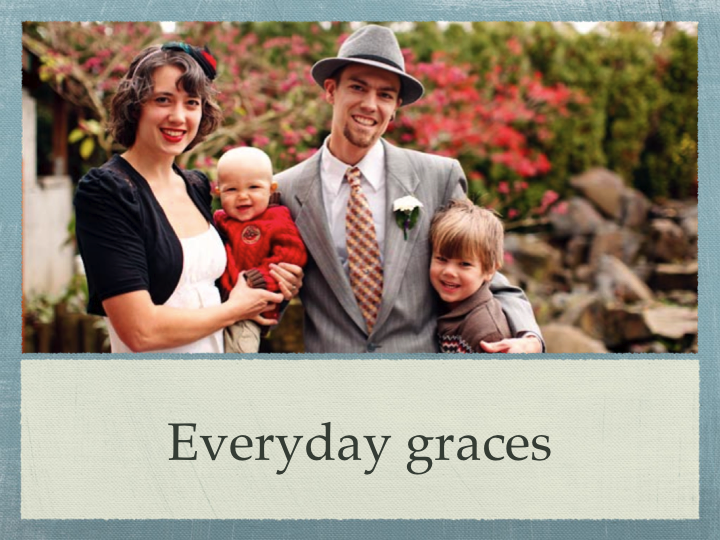
I want to start by sharing a little bit about myself and the forms of grace I encounter each day. I grew up a Quaker in Northwest Yearly Meeting and have found the grace of a family and home here. That doesn’t mean that everything is easy or pleasant here, but that I have a sense of connection and love, of rootedness and joy in the best of times, and at times a painful sense of disagreement with those I love and a difficult pull between wanting to please and wanting to have integrity about the truth I sense. In addition to this spiritual family, I’ve also built a literal family here in the Northwest. Here’s a picture of my family—Joel and I have been married almost 11 years, and that’s a grace in itself, since I come from a family of divorced parents and since relationships are never easy. I am so grateful for the grace of a life partner who’s just as stubborn as I, who will never give up on me, and who will wrestle through the hard times right alongside me. We have two boys—E is 5 and K is 18 months. I experience grace through each of them so often. K is a little love. He gives excellent hugs, throwing his little arms around virtually anyone’s neck and giving them a long, solid squeeze. I see people light up every day from the love he shares with abandon, and I desire to be that kind of person, too. E sees things going on around him and wants to help. We saw a homeless person last year and E wanted to know what we were going to do to help. We had a conversation about it, and eventually we decided to host a lemonade stand to raise money for a homeless shelter in town.

I see these small graces in the lives of those I’m closest to, though I often feel like it’s difficult to extend grace to myself, because I have high expectations for myself regarding living with integrity. But more on that later. So I have these glimpses of grace in my life and kind of an intuitive understanding of the concept of “grace” that incorporates beauty, extending more to others than is required and a gratefulness that I get to see these things and participate in them. But this isn’t a deep enough answer to me about what we really mean when we talk about “grace,” especially in a religious context. In one way, “grace” from God seems like a loaded concept, reminding us that we NEED grace (or reminding us that those who try to convince us of this theology SAY we need grace), that the world isn’t perfect, that I “sin” (whatever that is)—sometimes it feels like this sort of resigned God who is sitting around, sighing, saying, “OK, I’ll forgive you again. Here’s some more grace, since you obviously need it.” I guess what I’m saying is that when I look at the grace I see in the lives of those around me compared to my archetypal understanding of “grace” in a religious setting, I get two rather different pictures.


The problem with the way we often talk about grace in Christianity is that it almost feels like we first have to feel guilt and shame in order to receive grace. The problem with that is that grace is a free gift. I don't have to do ANYTHING--even feel guilty--in order to receive it. It's just offered to me. It’s just so abundantly above and beyond anything I can ever feel like I deserve that it feels like grace regardless of whether I feel guilty or ashamed.


The problem comes in because we think that in order to understand God’s grace, we have to think of ourselves as utterly depraved. I have a really hard time with the concept of complete human depravity. I don’t think it’s in the Bible. Yes, we’re all “sinners,” in that we all choose to walk away from God at various points in our lives (OK, every day, if you're anything like me), but I don’t think we’re at heart completely evil. It seems like Friends have generally had a fairly optimistic view of human nature: there is that of God in each of us—we’re created in the image of God. God speaks to and through each person. Everyone has the chance to respond to God.


When I was at a Reformed seminary I just could never get on board with this idea of complete human depravity, and I realized this optimism isn’t necessarily common to all Christians.  But I feel like we still have a tendency to get stuck there in this idea that we’re so evil that God had to come save us—or worse, that Jesus the Son had to come save us from God, the angry child-abusing capricious Father-deity who was willing to watch his own son die. We heap guilt on ourselves, but this distances us from God in an unhealthy way. Why should I be grateful for the grace of this God? This isn’t grace. It’s a fear-tactic. It’s holding something scary over our heads until we buckle under the pressure of our own depravity and plead with him to not be thrown in a lake of fire.  This is not the kind of grace we see in the Bible, if we really look.


The overarching theme of the Bible pictures a God who comes to people again and again to build relationship. People draw together as a community, struggling to figure out what it looks like to live in right relationship with God and each other. They make laws to try to codify what the perfect community would look like, but that doesn’t work so well. They notice that the really important part of faith is breaking down the systems (that always seem to crop up) that benefit the powerful by taking advantage of the poor or disadvantaged. Over and over again we see, starting with the law of Moses, that people are instructed to do what is right by the lowest in their society: the widows, the orphans, the foreigners. This is how their commitment to their faith is to be measured.


Stay tuned for parts 2 and 3: a word study on the Greek and Hebrew terms for "grace" and some of the scientific research that relates to the topic of "contemplating grace."

Friday, June 22, 2012

biking with kids: the next level

Last week we went to the next level in our biking set-up: we got a "tag-along bike" or "trailer bike." E is 5-and-a-half and he LOVES it! He was getting kind of big for our Burley double trailer, especially next to his 18-month-old brother. Plus, they're really heavy! We had an REI dividend burning a hole in our pockets so we sprung for the trailer bike you see below. E tried it out and was immediately hooked. Now he asks every day if we're going to be able to go anywhere on the bike. (The next thing we need to do is find some child-sized rain pants, I suppose. On Tuesday we got caught in the rain and he was soaked! I tried to convince him it was an adventure, but he didn't buy it.)

I'm not sure that the people who make the trailer bikes would officially suggest this, but we attached our Burley trailer to the trailer bike, so we have quite the train going down the road now! (I've seen other people do this, too.) It's actually made it a little easier to bike because E's weight isn't in the trailer. I suppose the extra wheel helps, and I'm pretty sure his pedaling actually helps a little bit. He can coast if he wants to, but when he pedals on hills I can tell he's pedaling. We don't go places as fast yet, because I'm making sure he's comfortable on the bike and isn't going to knock us over by leaning too far one way or the other. But I think soon we'll be comfortable enough to go at a normal speed. I can now cart around three kids, which I did the other day when we picked up my niece from Kindergarten. I assume I can also get more groceries now without overloading the trailer.

The hardest thing about this set-up is turning. I have to slow way down and make wide turns, and I have to make sure not to curb-check the trailer, since it's far enough back that it's a little bit hard to judge where the wheels are going to be once they get there. I assume this will get better with practice, so for now I just take it really slowly and it's been fine. Hills are also really difficult. I have to make sure to shift down with plenty of time or else all the momentum starts pulling us back too much!

My only criticism about this trailer bike is that it's kind of difficult to switch from one bike to another. It's not impossible but it takes a bit of effort to get it on properly. Once it's on it works very well, however.

If you're interested, check out this page about raising up biker-kids. You can see a trailer bike in action in a video. There's also a helpful video about teaching kids to ride a bike. (We've been using the push-bike method by just taking the pedals and training wheels off E's bike. He's getting the hang of how it feels to balance, and I'm pretty sure he'll be riding his own bike within the next month or two.)

Wednesday, June 20, 2012

pacific northwest quaker women's theology conference 2012, part 1

This last week I went to the Pacific Northwest Quaker Women's Theology Conference. It's a conference that happens every two years and brings together Quaker women from all over the Northwest (and beyond) and from the different Yearly Meetings and unaffiliated meetings in the area. In this post I'm going to tell you a few of my reflections from the conference and copy the really beautifully-written epistle that came out of our 4 days together. I had the chance to be one of the plenary speakers, so in future posts I'll write about what I shared with the group. I'll actually write an expanded version, because I had about 25 minutes to share and at least twice that much material (as usual)!

I am so grateful I had the chance to attend this conference. I've been wanting to go for the last several years but it hadn't worked out, so finally I got to go this year. The goal of the conference is to bring women together from different communities of Friends to build relationships and share about our faith journeys through narrative theology. I actually love spending time with Friends from various traditions, and as you know if you've followed my blog, I love theology. So this was right up my alley.

One thing that was fabulous for me personally was the space to sleep, pray, exercise, eat and participate in conversations without interruption by two little ones! My boys are great, but it was amazingly nice and restful to have a few days without them at a retreat center (Menucha) surrounded by women I enjoyed spending time with. My friend Darla and I went running almost every day (the last day we finally gave ourselves enough time to make our goal of finding the end of the Women's Forum Trail--kind of a good metaphorical end to our week--and we got muddy up to about mid-calf) and I practiced yoga with a few others under the direction of an experienced yoga-teacher-Friend, Ellen.

I also found it stimulating and encouraging to find Friends with whom my heart was in resonance from several other yearly meetings and unaffiliated meetings. I will treasure these friendships, and I'm excited to see where they go in terms of drawing us together as Friends. I hope we can start working together better on things we all care about, and that maybe we can start doing a bit more inter-visitation.

I went to Marge Abbott's workshop on prophetic ministry, which was excellent. I am so grateful that God is working in so many of us to bring truth to our communities through our own voices and talents. Prophetic ministry is a lonely business, and though most of us didn't have others there in that workshop from our own meetings, it's encouraging to know one another is out there, listening and attempting to follow through with action as led.

One woman I will not soon forget is Carol Urner. She came as another of the plenary speakers, and she's an octogenarian from Whittier Friends in California. She spoke about some of her experiences and ministries, and her main point was that we should "say 'yes' to God, even when we don't know where that will lead us." This, of course, is what we all strive to do, but she spoke with amazing passion that can only come from decades of putting this advice into practice. When I'm in my 80s I hope to have at least half the passion and stories of faithfulness that she has!

There were many other wonderful women and great events, but I think that's enough for now. I'll copy the epistle below so you can read of the communal experience we shared.


Epistle of the 2012
Pacific Northwest Quaker Women’s Theology Conference
June 13-17, 2012
Corbett, Oregon
Greetings to Friends everywhere. 
Grace permeated our days and wove the variegated fibers of our lives together into a tapestry of light and love much like the quilts that surrounded us in our meeting space at the 2012 Pacific Northwest Quaker Women’s Theology Conference. We gathered on June 13, 2012, at the Menucha Conference Center above the Columbia River near Corbett, Oregon, around the theme of Inviting, Contemplating, and Enacting Grace. Prior to the conference each participant wrote a short essay in response to the theme. The conversation among us began as we read each other’s papers online and throughout our time together.  We came with differing experiences among Friends and other faith traditions, some excited, others tentative about what we would hear, and feel, and do together. We came yearning for community, a place to feel at home. We came knowing we would be challenged to listen deeply, to learn to open and stretch, hoping the effort would yield deeper understanding and add new patterns and textures to our tapestry of grace as we were woven together.

Thursday morning we received a message from Ashley Wilcox on Inviting Grace.  Ashley opened with her admission of love for the Apostle Paul. Drawing from Acts 9 she showed us that sometimes we invite grace through doing the completely wrong thing.  We can also invite grace into our lives by accepting and giving loving acts and living words. Darla Samuelson taught us how to use specific disciplines to create a space for grace to touch the pain of shame that is common in human experience.

Friday morning Cherice Bock led us through a contemplation of grace through a word study.  She asked the provocative question, “Do we have to feel guilty to receive grace?” In answer to her own question, she proposed that grace is an undeserved gift with no strings attached. Cherice concluded that grace is active, social, and enduring. On Sunday morning we were gathered together for a final hour of worship in which Nancy Thomas brought us the challenge to carry gratitude with us in response to God’s grace.
As stewards of grace when we extend grace to others we receive grace into our own lives and are further called to extend grace in this world. Christine Hall continued by saying that in contemplating grace we are swept up in a love that connects us to God, one another, creation, and divine mystery.  She finished with a quote from Thomas Merton stating that through contemplation we “see through the illusion of our separateness.”    
Saturday, responding to the theme Enacting Grace, Carol Urner challenged us to say “yes” to leadings even when we do not know where our “yes” will lead us.   In that “yes” there is a river of light that will flow through us and sustain us.  Elenita Bales followed and reminded us that that the word “enact” contains “act.”  She encouraged us to develop a rhythm of faithfulness in speaking the truths that emerge from our souls, and to risk vulnerability that we may become a channel of change.  Quoting historic Quaker Ann Wilson, Elenita asked, “What wilt thou do in the end?” 
Afternoon workshops presented a variety of ways we can nourish our lives and create an opening for grace. In Writing as Spiritual Practice we explored several ways to begin and be faithful to our own spiritual writing.  A workshop on the Bible revealed that in spite of feelings about Scripture, ranging from anger through love, the group had an interesting and respectful discussion.  In a session entitled Speaking Holy Boldness participants considered viewpoints and experiences that made clear that prophetic witness is alive and well in our yearly meetings.  Another group shared the different practices, such as movement, meditation, prayer, and visualization they use to hold others in the Light.  In a session entitled The Hard Stuff women from different yearly meetings responded to questions that had been submitted in writing earlier. Participants engaged in respectful discussion that acknowledged our differences while encouraging understanding and acceptance.  One workshop focused on listening and care committees and offered guidelines and tools on how to support others through suffering. Judy Maurer shared her experiences and reflections on teaching, listening, worshipping, and working on social justice issues in Russia. Christine Hall introduced Way of the Spirit, an opportunity to engage in contemplative study through a new program in the Pacific Northwest. 

Evening activities provided opportunities to further be woven together in our tapestry of community. Thursday evening Roena Oesting, dressed and speaking as Elizabeth Fry, recounted major events from “Betsy’s” life as written in her journals.  We expressed gratitude for the way Elizabeth Fry’s work in prisons started a pattern of prison reform work among Friends that continues today. On Early Friday evening we listened to the experiences of those who attended the FWCC Sixth World Conference of Friends in Kenya. Their exchanges were fruitful, rich and full, though sometimes difficult. As we heard their stories we could sense that there, too, they were held by grace. Later, we danced, sang, played Hearts fiercely, worked on a HUGE puzzle, and created art.  All these allowed for new openings into one another’s hearts and connections through joyful exchanges. 

Throughout the conference threads of conversations at meals, home groups, over the puzzle, or on hikes further wove us together in beauty and grace. It was an amazing gift to sit at a meal and turn to a stranger and feel no awkwardness. On Sunday morning we were gathered together for a final hour of worship in which Nancy Thomas brought us the challenge to carry gratitude with us in response to God’s grace.  We came here to be ourselves and left affirmed in our appreciation for and joy in the deepening cross-yearly meeting friendship; that is grace.  Borrowing a sentiment from Carol Urner, we have to finish, but we have not yet begun. 

Thursday, May 17, 2012

moms & gardening

Since we just passed Mothers Day, I've been reflecting on the moms in my life, and on my own status as a  mom. (Here's me with my mom and sis last weekend!)

For the record, I wish that Mothers Day was Women's Day or something (and Fathers Day changed likewise), because I feel like it means we only celebrate those who have kids, as if only parents are valuable members of adult society. Having kids doesn't make us somehow whole or better, and it is not only our parents/grandparents who've shaped us. Why not celebrate all the women and men in our lives who have influenced us into being who we are today?

Anyway...growing up, I lived on 5 acres a few miles outside of a small town. (That is NOT me in the photo at left--this is my eldest last weekend when we went to the Bloom Festival at Tryon Life Community Farm.) Our 5 acres had a forested canyon, wide open fields and a huge garden. It was mostly my mom who grew vegetables, raspberries, kiwi, blueberries, rhubarb and strawberries. I remember my own little section of a bed one year in which I grew nasturtiums and cucumbers, but I wasn't really much of a gardener. My parents paid me 5¢ a hallek to pick berries, but other than that I was mainly tromping around in the canyon or inside reading books. My mom spent hours out in the garden and she enjoyed growing things, for reasons I couldn't really fathom as a kid.

My mother-in-law is a very talented landscape designer and she is also an excellent gardener. She and my father-in-law have transformed their .91 acres in town into a beautiful space that also produces a lot of food for them. They work together: my mother-in-law creating the plans and using her wealth of plant-knowledge to grow things, my father-in-law doing a lot of the weeding and harvesting, as well as picking fruit from the trees and drying it. We all worked together in the last 10+ years to create a trail that winds through the yard and a brick patio just outside the back door, but it's my mother-in-law who had the vision and could make the plan. Through her vision they've created a sanctuary back there that is beautiful, kid-friendly and lush, meditative and fun, practical and exotic.

(My step-mom has taught me a lot, too, but I've talked about her influence before, and though what I've learned from her has been similar in terms of creativity and the importance of doing things that are literally life-giving, her influence has been on slightly different topics. Many, many of the novels I've reviewed on this blog have been ones I've received from her. She's taught me a lot about what it means to live art, to cultivate and honor feminine spirituality, and to love dark chocolate and tea!)

My mom and my mother-in-law are very different people, but they both find joy in growing things. They, like the physical spaces they create, are beautiful and practical, joy-filled and in-process.

This year, we're putting a lot more time and effort into our little suburban farm. It's interesting, because I really don't like the concept of land ownership, especially since we took this land from Native Americans. It bothers me that this land is "mine" (at least it will be once we pay off the mortgage). It helps somewhat that it's not just mine, but it's my husband's and my mom's and it also belongs to my kids--we live in community, we bought this house and the lot on which it sits together. I struggle with the idea that we can "own" land.

And yet, having a sense of "ownership" for this land has been really helpful, too. We're learning to care for a physical space in a way we never have before. We're making it our own, but we're also attempting to make it beautiful and functional in order to better sustain life here and around the world. We have our own chickens, as I've discussed before, and we have a small garden this year. My mother-in-law made us an absolutely beautiful landscape plan for the back yard, which we mainly implemented last summer and are still working on this year. Incrementally, the space is coming together. And little-by-little, I'm learning to grow green things. In our garden we have raspberries, blueberries, strawberries, various lettuces, carrots, onions, potatoes, tomatoes, squash and pumpkins, peas, and we'll soon plant beans.

We also joined a community garden this year. We have a bit of space but not tons of space, so it's good to be part of a community of people who are growing some more things. Each individual or family is in charge of a bed, growing a particular thing. We meet for a few hours on Wednesday nights to weed, plant, harvest and share a meal together, and then we tend the garden when we can throughout the rest of the week. We're in charge of the peas and beans, and EP wanted to plant some flowers, so he has a little bed where he planted sunflowers. Hopefully it will turn out a little bit like the sunflower house pictured here. I'm excited to be part of this community! I want to learn what others know, experiment together and build community in the process.

I reviewed the book Dirt & the Good Life a few weeks ago and I'm excited to start putting this into practice in my own life. I'm grateful for the moms in my life who have cultivated me, even when it's messy and tedious and takes years and years and doesn't always go as planned and feels more like an experiment than something about which we have real expertise. By now they're "expert" moms, though, and I can go to them for advice not only about actual gardening but about growing up kids!

(By the way: another backyard project right now is the clubhouse that Joel's building for the boys! This blog post wouldn't be complete without some pictures of that! We also built a raised bed. By "we" I mean I cleared the space and measured things, Joel and Mom built it and I took pictures. There are also some pictures of us clipping the chickens' wings.)


Thursday, May 10, 2012

book review: the hunger games (& american politics)

I jumped on the bandwagon. I had emphatically decided I wasn't going to jump on this one, due to what I'd heard about the books' theme of children killing children in a Roman arena-like setting. I didn't want to support that. Even when I heard that the hero is actually a heroin and even when several of my friends read it and liked it. I also kept hearing stories on NPR, of all places, in the weeks leading up to the release of the first film: about the explosive popularity of the sport of archery, especially among girls; about women archers training for the summer Olympics; and of course buzz about the movie. (Warning: if you haven't read these books and plan to, go read the books first so I don't spoil anything for you!)

Then my husband threatened to go see the movie with or without me.

OK, OK, I'll go see it with you--but wait till I've had time to read the book first!

That was on a Saturday night. We watched the movie two days later on Monday night. And I'd finished the first book that afternoon, between taking care of kiddos (mine and my niece), prepping for and giving a lecture, doing my normal Sunday routine including meeting and an evening worship group which we hosted and for whom I made dinner. I got the whole trilogy on Kindle, which meant a) I didn't have to wait to buy the book at a store or have it sent to me, and b) I got the whole trilogy, which meant that immediately after I finished the first book I wanted to dive into the second book! I tried to show a little more restraint on the second one, but I started it Tuesday and finished it Thursday that same week. That's when I put my foot down and decided that I had to save the third book for the end of the semester, after I'd finished all my grading.

So as you might have guessed, I found these books extremely addicting, in a good way. I don't know that there's anything particularly amazing about the writing style in itself, but the story is compelling and the plot development is excellent. It's told in the first person from the perspective of the heroin, Katniss Everdeen. (Katniss is a cool name, by the way! If I had a daughter, and if I didn't think that name will soon become too popular, I'd totally name her that.) The world in which the Hunger Games books are set is a dystopian version of the future United States. It's no longer the United States, but it's set in the land where the USA is now. The government reminds me of the one in 1984: a centralized government  that has eyes and ears everywhere due to technology as well as human informants; theme of escape to the wilderness for respite; attempted control of the people via specific work assignments not based on aptitude but on location, etc. In The Hunger Games, the government is run from "The Capitol," and there are (or were) 13 districts, each in charge of certain things needed: agriculture, coal, weaponry, seafood and so forth. Each year they have what's called "the Hunger Games," where two contestants are chosen at random from each district to fight to the death in a human-made arena, but it's made to look natural (i.e., it's in a forest or whatever). Thinking about these Games defines the lives of most in the Districts (and in the Capitol): teenagers can get extra food for their families if they put their name in more times for the lottery. Watching the Hunger Games on TV is mandatory for all. In this way, the Capitol keeps its subjects...subjects.

Obviously, Katniss ends up in the Hunger Games. If you've read it, you know how--if not, go read it. The author, Suzanne Collins, created an interesting world where the contenders in the Games have to play to the crowd in order to have a chance at winning. As a reader you end up hating the people from the Capitol--but there's that point in the story where you have to realize, "As an American, I'm from the Capitol." We watch other people's struggles for existence on TV, and if their story captures our imagination it's possible that we'll send little gifts into the "arena" of life to give a little edge over competitors. This is "entertainment" for us and nothing more. As a middle class, educated American, I can spend my life learning about wars and conflicts, perhaps, and I may be genuinely sad when favorite "contenders" die, but I move on, happily raising my kids in this safe zone where they'll never have to fear becoming a contender in the real-life (life-or-death) Hunger Games.

And then there's the issue of politics and "spin." Katniss recognizes she's being used as a peon in a political game by everyone possible, and she (rightly) resents this. First she's used by the politicians of the Capitol to continue their game of subjugation through fear and degradation of the human spirit. When she later becomes the symbol of the rebellion of the Districts against the Capitol, she realizes she's being used again. She's willing to be used as a symbol--but only so long as this symbol is a rallying point for changing the political landscape into something that is more fair and equitable for all. When she realizes the politicians of the new order are going to reinstate the Hunger Games against the people of the Capitol (and several other inklings before this), she can't stand it anymore. She knows the political system that is going to be put in place will have exactly the same result as the former government did. The people at the top will be different, but there will be a "top" and there will be a "bottom." The system will remain the same, though the individuals will be shuffled around a bit.

This is what it feels like in our country right now. I vote, but I vote without a clear conscience. I vote for the least of two (or more) evils; I vote because I think this is the best system we human beings have thus far come up with--but I think this system is broken. Or maybe it's us who are broken--maybe it's me. We're so broken that it really doesn't matter which party is in power; we're going to bomb Iraq, Afghanistan and who-knows-how-many other countries almost daily. We're so broken that most politicians in both parties are cozy with Wall Street tycoons, special interests and lobbyists. We're so broken that if you get down beneath the rhetoric of most politicians, everything they do seems just about the same.

I believe there are good people in positions of political office, but we and the other lawmakers are making it pretty much impossible for them to get anything done that is actually good for anyone (or anything). We demand that they not change their mind, that they hold an extreme viewpoint on everything (either extreme right or left), and this makes it so no legislation can pass--and if it does, it's bogged down in loopholes or special interests. It doesn't matter who's in power--these things occur.

This brings me back to the Hunger Games. I guess I'm excited to see if this book catapults us into thinking about government differently. Can we see ourselves in the people of the Capitol? Can we see the obvious critique in the text of a simple change of hands of the same old power? Can we begin some kind of revolution to change what's going on--and do it in a way that will usher in something truly different rather than more of the same? Will Friends lead this charge, or back off until it becomes trendy?