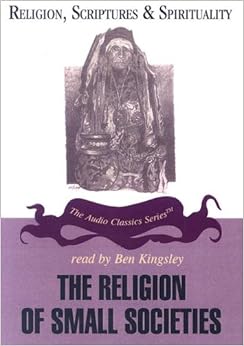
I recently listened to The Religion of Small Societies, by Ninian Smart, part of the Audio Classics Series on Religion, Scriptures & Spirituality (and narrated by Ben Kingsley, no less than Gandhi himself, right?). I think it's made for audio (as opposed to other books that are written for reading and only later are made into audiobooks). It was interesting and fairly well done.
I was most interested in the parts that had to do with numinous experiences that people had, where they encountered God/dess or a god/dess. These were really interesting and beautiful to hear about. The author talked about the difference between spirituality and other parts of life in that numinous experience, that experience of the direct presence of the holy. Shamans may have been the ones who most frequently had these numinous experiences, but it sounds like they sometimes happened to ordinary members of the tribe or group, too.
One reason that I wanted to listen to this book was that I have this growing sense that it's the vastness of our society that is one of the reasons we're seeing so many problems in our world. In a small society, there is accountability. Everyone pretty much knows what everyone is up to. There is no hiding in anonymity, and not as much ability to get lost in the shuffle and grow so lonely and depressed that you lash out through a school shooting, for example, or trafficking young children, or where you can take and take more resources than you need in a futile attempt to keep yourself from feeling vulnerable and alone. But in our society, there is no accountability like that, there is no way to make sure that everyone is doing OK, there is no effective mechanism that reminds us that others are hungry and that we must share.
Small societies often have religions that are place-based, that see God/dess in a particular place or that see the divine in the other animate and inanimate entities that make up their world. While perhaps this kind of animism is "primitive," a precursor to a more universal understanding of the divine, a God/dess who is present in all places and not bound to a particular plant, animal, or rock, sometimes I feel like our transcendent understanding of God gets in the way of our ability to connect with God on an immanent plane. When we as Christians became place-less and universal, we became so susceptible to the eventual wedding with empire that occurred with Rome, to the monoculture of convert or die, which wiped out so many of these small religions in the last 2000 years. A victory for Jesus, or just a victory for empire? It's so hard to tell sometimes.
Now as a people we're realizing that our disconnection from the land is harming not only ourselves, but also all the other creatures and non-living entities on the land. (Or at least, it's harming their ability to survive in the way that we have for thousands of years. We will all have to adapt.) Some of us are realizing that what these small societies did, creating accountability with one another, setting up guidelines for how to live in a way that did not overly-deplete the resources of our beloved place, were actually really smart. Perhaps as Americans we grew up learning that Native Americans didn't manage the land, so Europeans had to come in and do so for them, but now we're learning that Native peoples were managing the land, just in such a sustainable way that it looked natural. The size of their groups and the particular rules in place in their communities almost all contributed to maintaining the land for the benefit of all — not just the people but the entire ecosystem.
We obviously can't go back to that kind of society, but I've wondered for a long time what it would look like to live in this kind of tribal way, at least to form our meetings/congregations in such a way that we split in healthy ways when we get too big, and where we actually know one another and supply one another's needs. What if we not only did this for the people, but for the whole ecosystems to which we're connected? Some people are calling this watershed discipleship or place-based theology. What if we paid attention to the numinous experiences we had here, in this place, of the God/dess who is particular to here, and transcends space and time? What might we learn if we paid attention to being followers of Jesus here, rather than in some disembodied future?
Wednesday, October 28, 2015
Tuesday, October 27, 2015
mini book review: the game of thrones
Lest you think I only read high-brow literature and popular nonfiction in my spare time, I did also spend a good portion of my summer listening to the audiobooks of A Game of Thrones series by George R. R. Martin (technically, the series is called "The Song of Ice and Fire"). I started into this series by watching a couple episodes of the TV series, but those were too racy for me. The books are not as graphic. They were addicting, however! I found myself making up excuses to do dishes or laundry so I could listen to my audiobook. Luckily, a bunch of people at my library are also interested in this series, so I had to wait on a waitlist for weeks between each book, so I couldn't just binge my way through them (though I suppose it would have had a positive effect on my housework). The book is set in a different world where each season lasts many of our years. It's a medieval society with knights and horses and dragons, battles, love, intrigue, jealousy, a bit of magic and religion, and much familial drama.
I'm not sure what it is about this series that is likable. Just because a character is likable doesn't mean they'll survive (if you know anything about Game of Thrones I'm sure this isn't news to you — I heard about the end of the first book on NPR one day!). Usually I like sci-fi and fantasy because it lets the author and reader explore moral and ethical questions that aren't really possible to explore in normal life. But I can't say that these books have any shining moral truths to present, except, perhaps, that we don't always get what we deserve. It's an intriguing look at the "game of thrones," as in, the intrigue one has to participate in if one happens to be born into a noble family, or wants to participate in the life of lords and ladies. This is not a situation most of us find ourselves in nowadays, but I suppose the politics and attempts to get ahead are just as real, though far less bloody, at least here in the US.
I was excited to read the fifth book because I thought that would be the end of the series and there would be some kind of closure, but by the time I got half way through the book and realized none of these story lines were drawing to a close, and in fact new storylines were opening all the time, I looked it up and realized that the author is still working on the next book. Agh! I think book companies should do what Netflix and other video streaming places have been doing lately, and release a whole series at once so we can binge on it all at one time. None of this delayed gratification thing!
Seriously, though, I probably will keep reading it, as it's a good story. It definitely keeps my interest and entertains. The characters are unique. They're not exactly realistic or well-rounded, they're kind of like mythical foils without a lot of character depth, but they're interesting and you never quite know what they're going to do.
Monday, October 26, 2015
mini book review: in defense of food
I recently (finally) listened to In Defense of Food by Michael Pollan on audiobook. He tells us his main point right up front: "Eat food. Not too much. Mostly plants." Then he spends the rest of the book unpacking what this means: "eating," as in, not gorging, and eating as a social occasion rather than something we do by ourselves in front of the TV or just for the sake of ingesting nutrients. "Food," as in, actual food rather than some processed pseudo-food, and cooking it ourselves so we know what goes into it and so we're participants in the process and therefore value each bite more than we otherwise would. "Not too much," of course, refers to the American propensity to eat huge portions with high calories. "Plants" doesn't require much definition, except that with statistics like the fact that it takes 3-4 of today's apples to equal the nutritional value of one 1950s apple due to soil nutrient depletion as well as human selection for visual appeal and high yield, we have selected against nutrient content in many of our staple foods. He also suggests in the final pages that we participate in the food production process, if only by way of a small herb garden on a window sill, or more if we have space.
Another main point in this book is about "nutritionism." Pollan talks about the science of nutrition as almost a religion, and the irony that Americans are so fanatical about "health" and are one of the most unhealthy populations in the "developed" world.
He also gives a lot of information regarding "the Western diet," by which he means the processed food (or what passes for food) that many Americans eat. He says, interestingly, that pretty much any traditional diet produces fairly healthy people with low risk for "Western diseases" such as cancer, heart disease, and type 2 diabetes. People who eat any traditional diet are, on the whole, much healthier than the population eating a Western diet. Pollan cited a fascinating study of Australian aborigines who had adopted a Western diet and had developed diabetes. A researcher had them go out into the bush and hunt and gather for their sustenance again. The study lasted for 7 weeks, during which time they lost an average of 17 pounds and their diabetes was much more controlled.
Pollan connects the dots that a Western diet, although supposedly superior because it's based on science, is actually making us sicker. He gives a number of helpful and practical suggestions about how to eat more healthily, not just by falling into the trap of a shiny new diet to try (a nutritionist perspective), but by shifting our perspective from food as a means to the end of survival, to real food as an enjoyable experience in which we participate as a community.
Since this is a mini-review, I'll leave it there, saying I agree with Pollan's conclusions, and this is basically how I've been eating for several years now. But there are some criticisms of Pollan's approach, not surprisingly, from the field of nutrition and science. Since Pollan's point is basically that science's approach to food is to reductionist, these critiques are not surprising, but it is difficult for those of us having been brought up in a culture that relies so heavily on scientific evidence to just stop listening to science. I don't think Pollan would have us do that, but to pay attention to the ways that science is being used and the assumptions upon which it is based, striving for scientific processes that actually serve us rather than leading us down the path toward tinier and tinier meaningless reductionist minutiae.
Monday, May 11, 2015
why I was late to worship yesterday, a.k.a. reasons I love North Valley
Yesterday, my family and I arrived at the meetinghouse right on time for worship, and my husband ran in to help lead music. I, however, did not arrive until at least five minutes in, and it hit me as I took my seat how grateful I am to be part of the community at North Valley Friends because of all the reasons that made me late.
First, I was getting something out of the trunk when a Friend drove up and stopped to chat. She offered to loan us a 3/4 size guitar for my boys to learn on, a loaner we can keep as long as we like. Just that morning, my 8-year-old had been saying he wants to be able to do something to help in worship, and asking to take his full-size guitar to worship practice with his dad. He's been working hard to learn chords, but it's pretty challenging on a full-size guitar with hands his size, so this was a perfect and timely gift.
I pulled a bag of clothes out of the trunk to take to the ReThreads shed, a drop-off site for used clothes. ReThreads is open to North Valley folk as well as the rest of the community. A group of people from North Valley sort all the donations left in their storage shed, put them on hangers, and take them to a two-room "store" next to our meetinghouse. Last summer, they spent time fixing up the "store," painting it inside and out, adding decorations, and making the place inviting. My sons had long since run in to the meetinghouse for worship.
Before I could make it to the ReThreads drop-off, I saw someone in the parking lot to whom I was going to give a flat of onions. This summer, our community garden has expanded to not just the garden space on the meetinghouse property, but also to a coordinated effort with all the gardens of North Vally people who want to be involved. Each person is in charge of a particular crop, and we'll bring our produce to share with one another throughout the summer. Since I don't have room in my yard to grow a bunch of different crops, this is so exciting! I'm waiting in anticipation of what delightful produce will be shared, and I'm excited to share my own small offering.
To get to the flat of onions I had to move aside a bike rack we're loaning to some Friends for the week. We have an e-group at North Valley, and probably at least once a week there are emails requesting to borrow things and offering to give things away or sell them, in addition to emails about births, deaths, weddings, community news, and notifications about North Valley events. We've benefited from this e-group many times, and it's great when we can also help supply someone else's need.
I finally got to drop off my used clothes at ReThreads and went inside, where I found one son munching baked goods in the foyer. We get day-olds sometimes from a local bakery, and I picked up a loaf of bread to take home to nourish our family for the week. Meanwhile, I chatted with two wonderful ladies whose lives intersect with mine not often, but deeply.
By this point I had thoroughly lost my children. I went into the meeting space and looked around, confusedly, before a Friend pointed toward the children's wing. I went to check on them, and they were already in their "places of worship," engrossed in that work and at home in their place.
I returned to the adult meeting space and joined the song.
Tuesday, April 28, 2015
mini book reviews: the river why
I decided to start a series I'm calling "mini book reviews," because I read tons of books right now, and I don't have time to write full-fledged reviews, but I want to share them with you all anyway. I'm going to write whatever I can write in 15 minutes. Ready, go!
I'm starting with David James Duncan's The River Why, which I just "read" as an audiobook. Audiobooks are the best, by the way! I love listening to them while I'm cooking, doing dishes, gardening, folding laundry, etc. I get them from my public library.
This was my third time reading The River Why, and each time has been a very different experience. I read it in college for a class, and I hated it. I was so bored with the details about fly fishing and bait fishing that I didn't really see the humor or the philosophical poignancy of it. I think I pretty much skipped most of the last third and just read the end, so I missed the best parts. (Sorry, if you're reading this, Professor Higgins!)
The second time I read it, I loved it! My husband is a fly fisherman, so I had a bit of a vested interest in understanding the sport. Since I didn't have a time limit to finish reading it, I read it slowly and realized how funny it is. I was in a similar life stage to the main character, Gus, just growing up and leaving home, trying to figure out what life is all about, gathering folks who seem to know something about such things, and building a sense of who my people, my community, were going to be. I loved Gus's internal quests that required natural spaces as well as times sitting around reading books and/or talking to people. I loved the questions and the mystery, the hinted answers, the resolution, the humor threading through it all and the sense of the transcendent-immanent Ultimate.
Having been to seminary since reading the book last, this time I found myself analyzing Duncan's theology and philosophy with a more nuanced understanding. I agreed with some of his characters' philosophies, but there is also a subtle hierarchy, where he suggests through the philosopher in the story that the ultimate created being is humanity, the pinnacle toward which all other creatures want to climb. I struggle with this concept now, since it has caused so much harm to the rest of the created order.
Much of the philosophy I appreciated, however. I loved how he weaves together overtly Christian metaphors and stories with ideas of vision quests and finding God in the natural world. He doesn't force people to be Christian, but he leaves the door open. He expects them to find God in their own way, completely in their own bodies, when they're most in contact with the world around them.
I loved hearing Gus's story, but I also enjoyed overhearing (through his experience) the relationship between his parents. Reading it this time, I realized I see it from the perspective of the parents more than the coming-of-age young man. This made me feel old, but also just in the place I'm supposed to be right now, and I was encouraged by the joy and meaning that the two very different parents made with one another as they learned to truly be themselves without fear of the other.
Thursday, April 23, 2015
writing elsewhere
Although I haven't managed to keep up well with this blog lately, I've been writing a lot elsewhere! If you'd like to read it, feel free to follow the links.
Of particular interest to those of you who follow this blog because of our Quaker connection, I had a couple pieces published in the last edition of Quaker Life Magazine. Kindred Courage connects my own life and ministry with the inspiring example of Elizabeth Fry, and the beautiful book of poetry about Fry by Friend Julie C. Robinson, Jail Fire.
Quaker Life also re-published pieces of the Peace Month 2011 curriculum, SPICE: the Quaker Testimonies, and SPICE: a Quaker Youth Curriculum.
I've also been writing regularly on the blog for the journal I edit, Whole Terrain. I've been enjoying talking with documentary makers and authors to review their work, and learning about all the excellent environmental thought and activism going on out there. As a "journal of reflective environmental practice," I feel like Whole Terrain's ethos lines up well with my own Quaker desire for the coupling of reflection and activism.
Here are some of my favorite pieces I've written lately:
- DamNation: Whole Terrain interviews documentary filmmaker Travis Rummel
- Early Spring: Whole Terrain interviews Amy Seidl
- "Hottest Year": building trust in climate science
- Plastic Paradise: Whole Terrain interviews documentary filmmaker Angela Sun
- Nature's Trust: a conversation with author and law professor Mary Wood
Thursday, September 25, 2014
my environmental history
![]() |
| Photo of my grandpa, Ralph Beebe, and me a few years ago when we got to teach a class together (Photo credit: Joel Bock) |
For my Environmental History class this semester, I got to conduct an interview with a family member regarding my own environmental history. I enjoyed meeting with my grandpa, Ralph Beebe, and talking with him about his recollections of his own life and lives of his parents as they established homesteads in Idaho. It was fun talking with him about issues we'd never thought to talk about before, like how his family got food when he was a kid. I learned I have a lot in common with his mother, canning and growing a lot of our food, and I'm a composite of him, his mother, and my own parents: connected to the land, focused on faith and social justice, and interested in organic, healthy food options. These come down to me through different generations so that I do not share the same concerns and worldviews as do my ancestors, but I can see how each of these values came to me through my family history. And do, without further ado, my story.
I spent some time with my maternal grandparents recently. My grandpa, Ralph Beebe, has a PhD in history, and at age 82 he's currently working on a memoir of his life. This assignment gave me the excuse to talk with him about memories I hadn't discussed with him before. I greatly enjoyed meeting with him and learning more about his life and perspective. (My grandma, unfortunately, has Alzheimer's, and so I learned about her family through my grandpa, as well as through stories my great-grandma Hazel wrote down, but I don't have the space to discuss that part of my history here.)
He and I both live in a small town in western Oregon's Willamette Valley. To me, this feels like my family's home. This is where I grew up and where my dad grew up; it's where my parents went to college and met. But just a few generations back, my ancestors lived in the midwest and then in Idaho and eastern Oregon. I'll mainly focus here on my grandpa's recollections, due to the brevity of this paper. I'll add a few thoughts about my dad's side of the family toward the end.
![]() |
| My great-grandparents' grave stone |
Ralph's father, Glen, was born on a farm in Cheyenne, Wyoming in 1894, and his family moved to Rupert, Idaho around 1914 for now-unknown reasons. Similarly, Ralph's mother, Fanny, was born in 1900 and grew up on a farm in Missouri. She moved to Rupert, Idaho with her father and two brothers (out of a total of 10 siblings) in 1914. She conducted all the chores that go along with running the house as her father and brothers homesteaded their new land. This included cooking, growing vegetables, butchering and preparing meat, and going out with a rifle to shoot rabbits. There is no current family memory of where these families came from before the midwest, although we are presumably mainly of European descent.
![]() |
| Cattle ranch in Idaho, similar to my great-grandparents' homestead |
Ralph remembers their cash crops as dairy cows, alfalfa, wheat, sugar beets, and corn (though the alfalfa mainly fed the cows). He remembers his mother gardening and raising chickens and pigs, along with the farm's many dairy cows. He helped weed the garden and gather eggs. He also remembers harvesting beets. They lived mainly on the food his mother canned, as well as the eggs, milk, and meat from their animals. He remembers getting a refrigerator after World War II.
He had the opportunity to go to college, which he considers very lucky, because he says he's not smart enough to be a farmer. He's book smart, of course, but not as mechanically minded as one needs to be in order to fix tractors, fences, and everything else that can go wrong on a farm. He moved off the land, but his brother stayed, and his nephew now runs the same farm. I've been there a number of times, floating the irrigation ditches on inner tubes as a kid.
I asked my grandpa his thoughts on the changes that have occurred in his lifetime. He recognizes that some people are really connected to the land that they work, the land that raises food for them and their families, but he never had that sense of the land. He likes the farm, and he appreciates the people who work it, and the hard work they do, but for him, a connection to the land seems like more of a personality characteristic or personal interest someone might have, rather than something everyone will experience.
![]() |
| My dad's 12th birthday |
One final note regarding my dad's side of the family is that my dad moved to Oregon, from Iowa in 1963, and the house he grew up in is now part of the property of the university where I coordinate a community garden. There are fruit trees in the backyard of his old house and the neighboring houses--apples, pears, and plums--and I've been preserving the apples from those trees this week.
In the scope of human history, my family does not have a long history on this land. But in the scope of present-day American experience, I'm incredibly connected to this town, this little corner of the Willamette Valley called Chehalem Valley. I'm putting down my own roots here, benefiting from the forethought of my grandparents and their friends when they planted the fruit trees that will sustain my family this winter.
As an aside, I've attached a photo I took of my grandma's ration card booklet from World War II!
Subscribe to:
Posts (Atom)


